The Agroecological Knowledge Toolkit
There is an increasing awareness that local knowledge and practices should be recognised in developing initiatives aimed at sustaining and improving the livelihoods of farming communities and the environment. Interest amongst research, education and development institutions to investigate and document local knowledge has grown significantly over the last few years. The University of Wales, Bangor is a leading institution in the development of a knowledge-based systems methodology to acquire and use local knowledge in research and development.
The AKT5 system is primarily concerned with gathering local ecological knowledge (LEK). Local ecological knowledge refers to what people know about their natural environment, based primarily on their own experience and observation.
Where management has a large impact on the natural resource base, it is useful to refer to it as agroecological knowledge, to emphasise the management component.
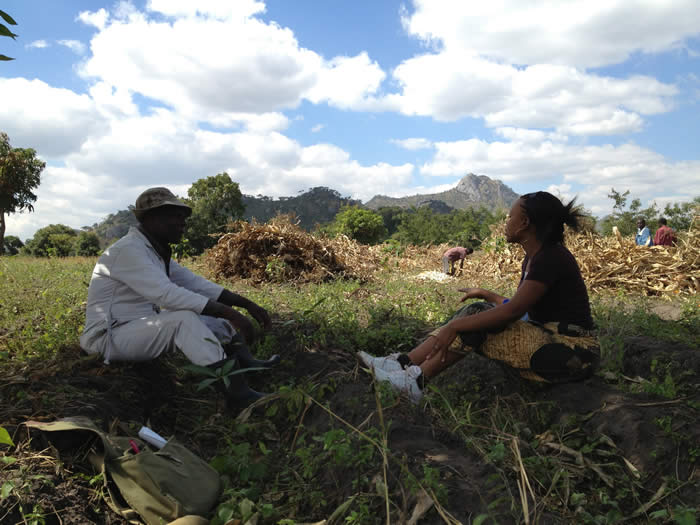
Local knowledge aquisition in Lesotho, 2003
For local knowledge to be used in natural resource management we need effective methods for gathering and evaluating it. One method that has been developed to enable explicit representation of local knowledge is the use of a knowledge based systems approach. This is a methodology for formally representing qualitative knowledge on computer. It is based on the premise that most knowledge can be broken down into short statements and associated taxonomies of the terms that are used in them. These can then be represented on a computer as a knowledge base using a formal grammar and a series of hierarchies of terms. Connections amongst statements can be explored by viewing sets of related statements as diagrams. The formal recording of knowledge in this way also makes it possible to use automated reasoning procedures to help evaluate and explore complex knowledge domains.
The Agroecological Knowledge toolkit (AKT5) software was developed by the University of Wales, Bangor , in conjunction with the Department of Artificial Intelligence at Edinburgh University (see Sinclair and Walker, 1998; Walker and Sinclair, 1998). It was designed to provide an environment for knowledge acquisition in order to create knowledge bases from a range of sources. It allows representation of knowledge elicited from farmers and scientists or knowledge abstracted from written material. The use of formal knowledge representation procedures offers researchers the ability to evaluate and utilise the often complex, qualitative information relevant stakeholders have on agroecological practices. The methodology associated with knowledge elicitation for the AKT5 system allows for formalized flexible knowledge bases to be created.
The process of acquiring and representing knowledge using this system is described in the AKT5 Manual (Dixon et al. , 2001). Essentially during knowledge base creation, knowledge is elicited through a process of semi-structured interviews with key informants. This knowledge is then broken down into unitary statements, and represented using a formal grammar, in either a statement or diagrammatic format. The process of representation requires iterative evaluation of the knowledge as it is inputted and therefore provides the basis for further questioning; the process of elicitation continues until no further knowledge is available. This process permits very robust knowledge bases on specified topics to be created. This allows for a system where the knowledge is stored in a form that is comprehensive, accessible and easily updateable. The system also allows knowledge bases developed from distinct sources to be compared through the use of automated reasoning tools, and thus provides a flexible research resource. This allows local and scientific knowledge to be compared and evaluated.
Using the knowledge based systems approach is not intended to provide definitive or prescriptive answers for researchers but to ensure that an environment exists where it is possible to explicitly consider the knowledge held by the communities that projects are potentially trying to influence
Work using the AKT5 system has shown that farmers can have highly sophisticated knowledge of their farming systems, which can extend beyond the scientific knowledge currently held (Thapa et al. , 1995). The methodology has been used successfully in a number of projects, critically with work on local knowledge of tree fodder in Nepal (Thapa et al 1995; Thorne et al, 1999) and is currently being used in a number of projects being carried out in Africa, Latin America and Asia by organisations such as ICRAF (The World Agroforestry Centre) and the Tropical Agricultural Research and Higher Education Centre, Costa Rica (CATIE).
For more information on AKT5 and Local ecological knowledge please see Reading materials
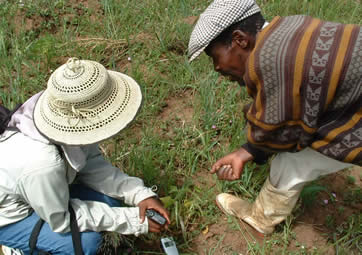
Researchers interviewing a cocoa farmer in Ghana, 2008
If you require further information or have any queries please contact us at akt5@bangor.ac.uk